

Goals of state modernisation and digitalisation
With the state government's programme for state modernisation and digitalisation, the Hessian state administration is making itself fit for the future.
Main objectives
- To make consistent use of the opportunities offered by electronic information and communication tools and to optimise processes (digitalisation)
- To provide services to citizens and businesses more quickly and easily
- To improve the overview of state services
- To save personnel and material costs in the state budget without reducing the quality and quantity of services provided to citizens and businesses
Steering committees
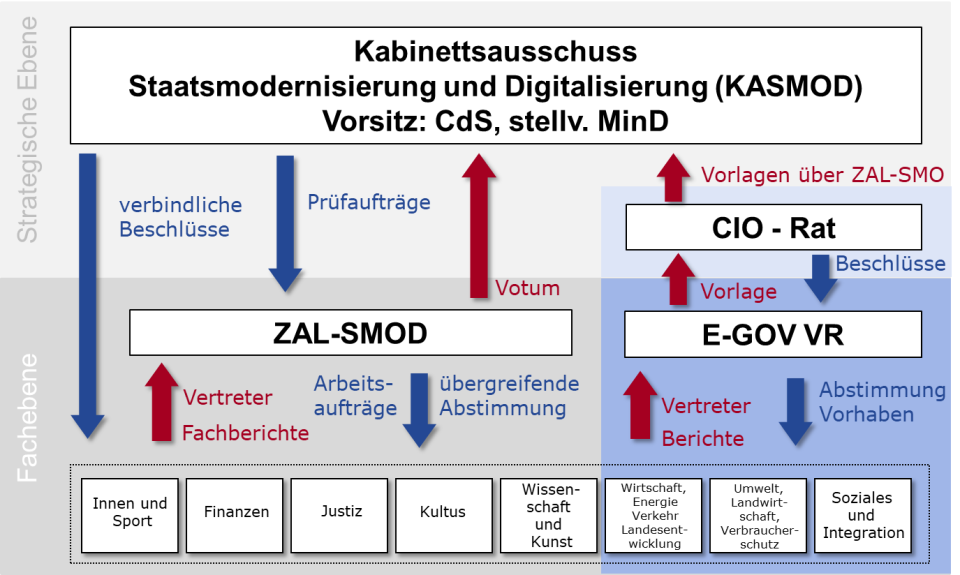
In order to achieve the aforementioned objectives, a committee structure has been set up to ensure that the technical level is closely linked to the strategic level, thus ensuring that all decisions are made on a technical basis.
At the same time, centralised coordination ensures that all reform measures fit together and that they are implemented uniformly across the country:
Cabinet Committee for State Modernisation and Digitisation
In Hesse, modernisation efforts are managed at an overarching level and projects are coordinated. This task is the responsibility of the Cabinet Committee for State Modernisation and Digitisation. It is chaired by the Head of the State Chancellery. The cabinet committee includes the heads of all ministries as well as the Commissioner for E-Government and Information Technology (CIO) and the State Commissioner for Efficiency in Administration.
The Cabinet Committee concretises the objectives for the reform process. The coalition agreement serves as the basis. The objectives set out specific targets for each project, measures with a detailed timetable and the expected improvements and savings.
ZAL-SMOD
A committee consisting of the central department heads of the ministries under the leadership of the State Chancellery (ZAL-SMOD) is set up in preparation for the meeting of the Cabinet Committee and to relieve it of detailed technical aspects that do not require a decision. This is where the initial consultation and preliminary coordination of the documents submitted to the Cabinet Committee takes place.
CIO Council
Proposals with a focus on digitalisation are discussed in a separate committee chaired by the CIO, the CIO Council. Its members are the digitalisation officers of the ministries.
Lead ministries
The technical reviews and implementation measures are ultimately carried out by the respective lead ministry with the involvement of the affected employees (staff representatives, women's representatives, representatives for severely disabled employees), the State Chancellery and the respective departments. The lead ministry reports to the Cabinet Committee at regular intervals on the progress of the reform work.
Once the reform project has been implemented, the ministry submits a final report to the Cabinet Committee, on the basis of which a decision is then made. In the case of projects of particular political importance, the Cabinet may also be involved in the decision.
Working methods in the area of state modernisation
Central focus on digitalisation
A key focus of current efforts to modernise is the digitalisation of the administration.
Government information and services are to be made available on the internet and internal administrative processes are to be optimised using electronic systems. This will benefit companies and citizens alike.
In Hesse, the state's Chief Information Officer (CIO) is responsible for the overarching digitisation of the administration. This responsibility falls under the remit of the Minister for Digital Strategy and Development. This is where efforts to digitalise the administration are dovetailed with those in areas outside the state organisation, i.e. in business and society. A total budget of 1 billion euros is available for the current legislative period.
Further information on the objectives, plans and projects can be found on the website of the
Hessian Ministry for Digitalisation and Innovation.
In addition, there are also the key topics:
- Personnel management
- New administrative management
- Task criticism
- organisational reform
- Deregulation
Focus on personnel management
As a service provider for citizens and the economy, public administration relies on personnel as one of its most important resources. Efficient personnel management is therefore becoming increasingly important in the face of demographic change.
Further information on personnel management
Focus on new administrative management
The aim of New Administrative Management (NVS) is to increase the transparency and efficiency of administrative action. The instruments of this reform project are characterised by business management and at the same time take into account the special features of public administration.
Further information on New Administrative Management
Focus on task criticism
In the course of a task review, tasks are scrutinised to determine whether they are still needed at all - and if so, whether they should be performed by the state or a private party or whether they could be performed in a different, possibly better way.
The term therefore encompasses criticism of purpose and criticism of implementation. Criticism of implementation is only directed at existing tasks. Its purpose is rationalisation. Criticism of purpose extends to new and existing tasks and is intended to ensure that no tasks are carried out by the public administration unless this is really necessary and is done in the best possible way. In principle, the corresponding review is seen as an ongoing task that requires constant updating and extends to all areas of the state administration.
Further information on task criticism
Focus on organisational reform
The aim is to improve organisational structures in such a way that tasks can be carried out more effectively and efficiently in the state's departments and thus ultimately in a more citizen-friendly manner.
More information on organisational reform
Focus on deregulation
Less bureaucracy - more responsibility on the ground
On the one hand, citizens and companies should be restricted as little as possible in their free development by laws and regulations. On the other hand, legislators and the administration must not be hindered in their necessary work. The country's reform efforts are characterised by this tension between too much and too little regulation.